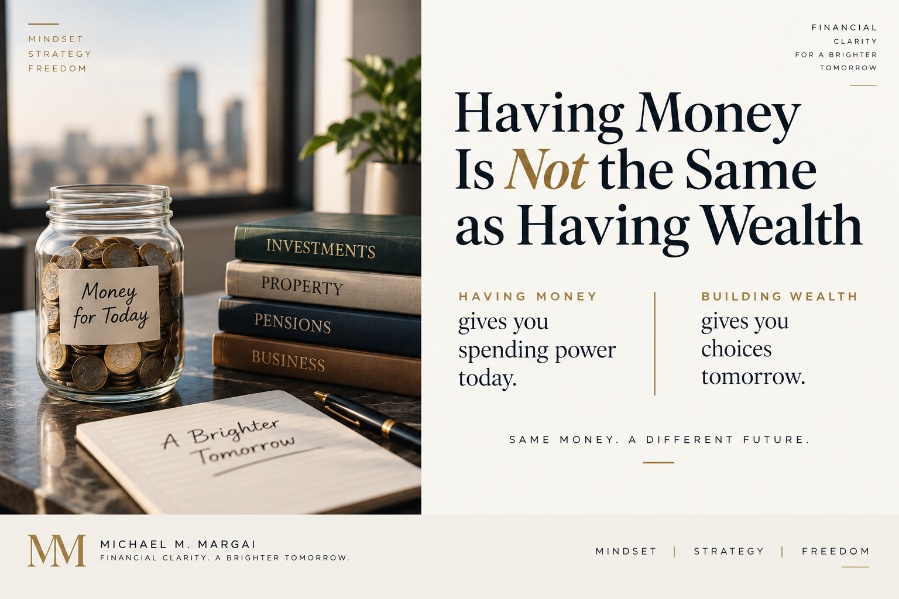
Income gives you options. Assets give you freedom.
I think one of the mistakes we make when talking about wealth is assuming that having money means you are wealthy. It doesn’t necessarily.
You can earn a very good salary, have a decent amount of money sitting in the bank and live comfortably, but still not be building much wealth. You could even have two people where the person earning less is actually better off financially. It all comes down to what they have done with their money over the years.
For me, the important question is not simply how much money you have. It is what you are doing with it.
Of course, earning well is a good thing and we all need some money in the bank. We need cash to live and having some put aside gives us financial security. But at some point, if you want to build wealth, some of the money you earn needs to start working for you.
Why we like holding cash
I completely understand why people like seeing money sitting in their bank account. Knowing that the money is there can make you feel secure, especially if you know what it feels like not to have much money.
If you have £10,000 or £20,000 sitting there, you know that if something happens you have money available.
That is sensible up to a point. We should have savings and we should certainly have an emergency fund.
But there comes a point where you have to ask yourself a simple question: what is this money actually for?
Let’s say you have £10,000 that you don’t need for anything in particular. You leave it in your current account and ten years pass. You check the account and the £10,000 is still sitting there. It looks like nothing has changed.
Except quite a lot has changed around you.
Your shopping costs more. Transport costs more. Eating out costs more. Property may cost more. That same £10,000 simply doesn’t buy what it used to.
So although you haven’t physically seen money leave your account, you have still lost something: what that money can buy you.
Give your money a purpose
I prefer to think about money in terms of what I need it to do for me.
I need some money for my everyday expenses. I need money available if something unexpected happens. I may also be putting money aside for something I know I want to do in the next couple of years.
But what about money I won’t need for another ten, twenty or thirty years?
Should I treat that money in exactly the same way?
Probably not.
Money I might need next month is not money I want to be taking much risk with. I need to know I can get to it when I need it.
But money that I don’t intend to touch for many years is different. Leaving all of it sitting in cash could mean missing years of potential growth.
There is a cost attached to the choices we make with money, including the decision to do nothing with it. You might not see that cost immediately, which is probably why it is so easy to ignore. Over a long enough period, however, it can really add up.
Earning more doesn’t always solve the problem
I see another version of this with people who earn good money.
You would assume that once somebody starts earning significantly more, they will naturally start accumulating more wealth. Sometimes they do. But sometimes very little changes.
You get the promotion and suddenly there is a little more room to spend. Maybe you change the car. You start taking better holidays. You eat out a little more. You don’t think twice about getting an Uber when you might previously have taken the train.
None of these things is necessarily a problem.
The problem is when almost every increase in income is followed by an increase in spending.
You can end up earning considerably more than you did five years ago but still wondering why there isn’t much left at the end of the month.
This is why I don’t think someone’s salary tells us very much about how wealthy they actually are.
What interests me much more is what they have managed to keep and what they have done with it.
And I don’t mean that we should stop enjoying our money. Money is there to be enjoyed as well. There has to be a balance.
There is nothing wrong with enjoying your money today. But you don’t want to reach your 50s or 60s and realise that you enjoyed almost all of it and built very little with it.
Moving from earning money to owning assets
For most of us, our financial lives begin in roughly the same place. We work and get paid for the work we do.
There is nothing wrong with that. It is how most of us will generate the majority of our income, particularly in the earlier stages of our working lives.
The difficulty is that if your entire financial position depends on you continuing to work, there is a limit to the freedom your money can give you.
At some stage, I believe we have to start converting some of the money we earn into things that can have value beyond our next payslip.
For one person that might mean building their pension. Someone else may invest, buy property or build a business. Most people who build wealth will probably end up owning a mixture of assets over their lifetime.
Exactly what you choose isn’t really the point I’m making here. First, you have to understand why owning assets matters in the first place.
Instead of only looking at your bank balance and asking yourself how much money you have, start asking another question:
What am I building with the money I earn?
I think that question tells us far more about where somebody may be financially in ten or twenty years.
Wealth takes time
Perhaps the least exciting thing I can tell you about building wealth is that, for most people, it takes time.
We naturally hear about the exceptions. Someone makes a fortune from one investment. Someone sells a business for millions. Someone’s life appears to change almost overnight.
Those stories are interesting precisely because they aren’t the normal experience.
For most people, wealth will come from doing fairly ordinary things consistently for a very long time.
Keeping control of expensive debt. Having money available for emergencies. Spending less than you earn. Putting money aside regularly. Investing with the future in mind and, importantly, sticking with it.
It isn’t something where you should expect to look at your finances a few months later and suddenly feel wealthy. Even after a year, the change might not feel enormous.
But do the right things consistently over many years and that is when you can start to see a very different picture.
This is ultimately why I make a distinction between having money and having wealth.
Having money is important. It gives us options today.
Building wealth is about making sure we still have options tomorrow.
And for me, that is the real purpose of wealth: security, choice and freedom.
The value of investments and any income from them can fall as well as rise and you may not get back the original amount invested.
Perfect Protect Financial Planning is a trading name of Perfect Protect Limited, which is an appointed representative of The Openwork Partnership, a trading style of Openwork Limited, which is authorised and regulated by the Financial Conduct Authority.
Approved by The Openwork Partnership on 10/09/2026